Could a smart algorithm be the new rural clinic that shows up at your kitchen table?
AI’s already powering telehealth, remote monitors, and mental health visits so people in remote counties get earlier checks, fewer emergency trips, and care that fits busy lives.
This shift means diabetes and blood pressure get tracked between visits, expectant moms stay safer with home readings, and therapy is just a scheduled video or phone call.
Thesis: practical, low-bandwidth AI tools are closing distance, flagging problems faster, and cutting avoidable travel for rural patients.
AI-Powered Telehealth And Remote Patient Monitoring In Practice
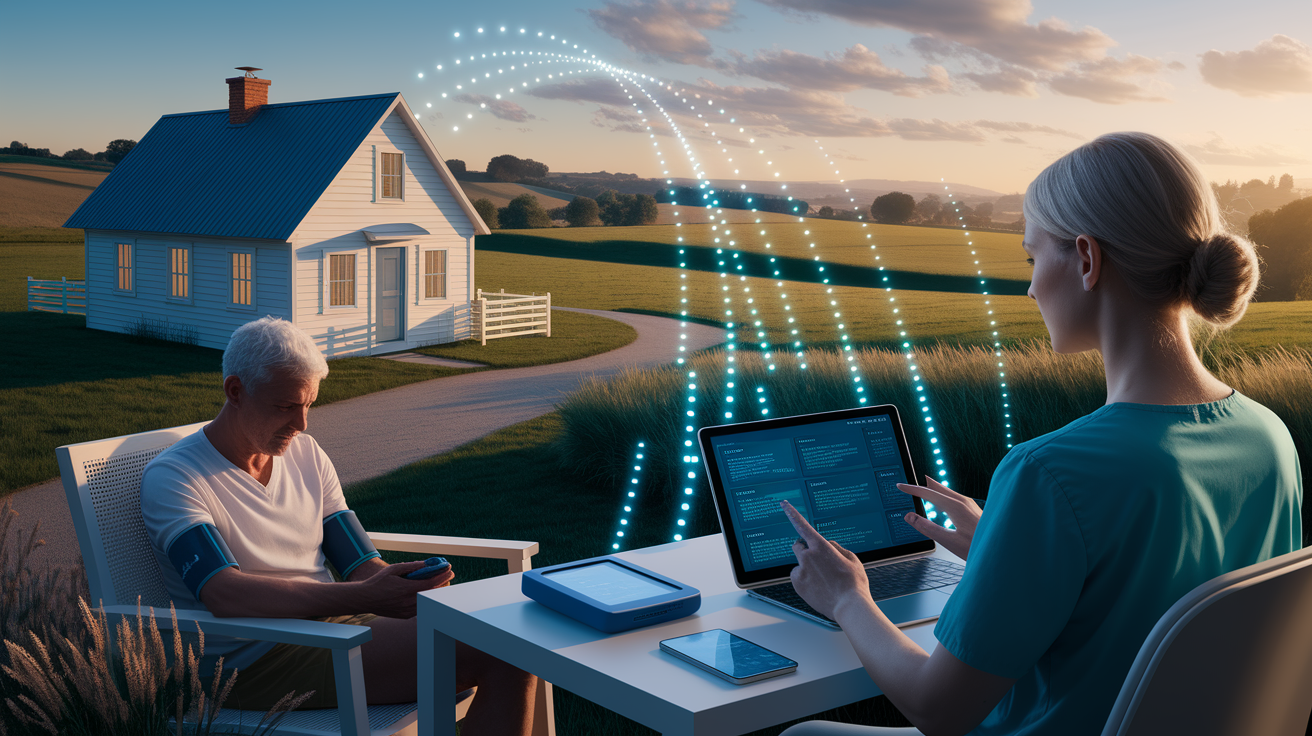
Not every rural visit can be a video call. When broadband’s unreliable or just not there, providers lean on audio-only telehealth, low-bandwidth platforms, store-and-forward transmission, or delayed data uploads that sync once a connection shows up. These workarounds keep care moving even in places where a stable video stream is wishful thinking.
Chronic Disease Monitoring For Diabetes And Hypertension
The workflow usually starts small. A patient takes a scheduled glucose or blood pressure reading at home, and that reading gets sent to a care team for review. If a result crosses a concerning threshold, an alert triggers follow-up, maybe a medication review, a coaching call, or in more serious cases, escalation to urgent care. Costs here center on the devices themselves, plus the staff time needed to actually review incoming alerts instead of letting them pile up. In areas with spotty connectivity, systems often fall back on delayed transmission or offline data capture until service returns. The real measure of success shows up over time: better glucose control, steadier blood pressure readings, faster time to intervention, and fewer emergency room trips for problems that could’ve been caught earlier.
Remote Maternal Health Monitoring
For expecting and new mothers in rural areas, scheduled virtual check-ins paired with home measurements, like blood pressure or weight, can keep prenatal and postpartum care on track without constant travel. If a reading looks concerning, or a patient reports symptoms that raise a flag, the care team has an escalation path ready. Often that means a same-day call, or an in-person visit if needed. Getting this right depends on patients having access to the right devices, proper training on how to use them, and clinician coverage that can respond quickly when something looks off. Success gets tracked through completed prenatal visits, how quickly concerning cases get escalated, and how much avoidable travel gets cut out along the way.
Telepsychiatry And Mental Health Access
Mental health support has long been one of the hardest services to reach in rural communities, and telepsychiatry has quietly changed that math. Virtual sessions let patients connect with a psychiatrist or counselor without driving hours to the nearest provider, and that alone opens the door for people who’d otherwise just go without care. Sessions can be scheduled around work or childcare, and follow-ups happen far more consistently when there’s no travel involved. The tricky part is matching patients to the right level of care and making sure crisis situations still get handled fast, since a screen can’t replace an in-person response when someone’s in real danger. Even so, for routine therapy and medication management, it’s closing a gap that’s existed for decades.
Final Words
AI improves rural access by enabling remote consultations, continuous monitoring, local AI-assisted diagnosis, automated triage, and smarter allocation of scarce clinicians. Those tools bring care closer to home, cut unnecessary travel, catch problems earlier, and help small rural teams care for more people without burning out.
The crisis is real. Rural residents face 23% higher mortality, 10% of communities have no providers, and over 40% of rural hospitals are at risk. Seeing how AI improves access to healthcare in rural areas gives a clear path forward: smarter tools, steadier local services, and better chances for patients.
FAQ
Q: How can AI be used to improve healthcare in rural areas?
A: AI can be used to improve healthcare in rural areas by enabling remote consultations, continuous monitoring, local AI-assisted diagnosis, automated triage, and smarter clinician allocation—bringing care closer and helping small teams serve more patients.
Q: How to improve access to healthcare in rural areas?
A: Improving access to healthcare in rural areas involves expanding telemedicine and broadband, supporting mobile clinics and local clinicians, using AI for remote care and triage, boosting transportation, and funding provider incentives.
Q: What is the 30% rule in AI?
A: The 30% rule in AI refers to a common guideline that a model or intervention should produce roughly a 30% or greater measurable improvement to justify deployment; its exact meaning varies by context.
